Published
DESCRIPTION
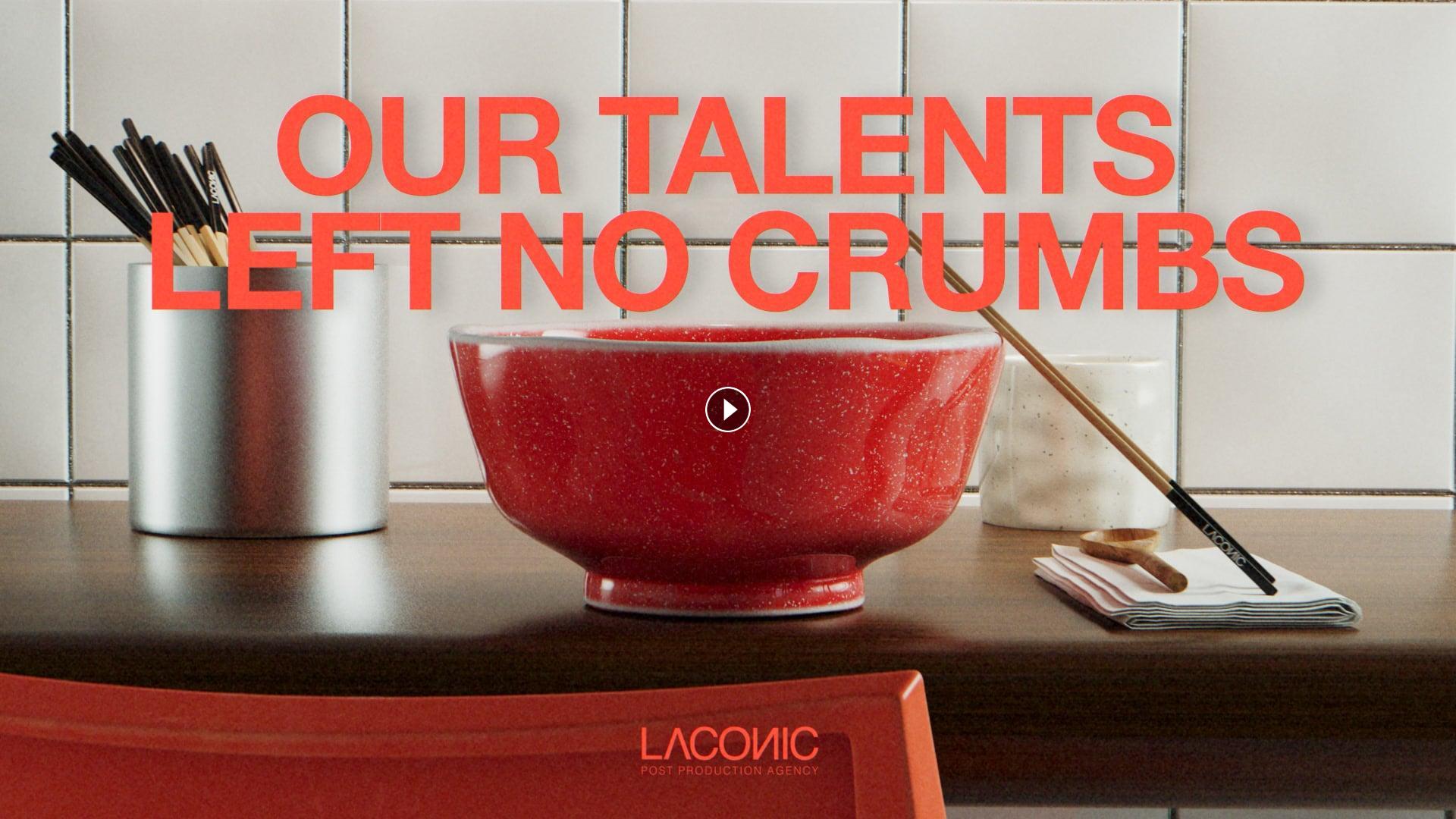
Laconic – Our Talents Left No Crumbs (VFX Breakdown) | 2026
Client: Laconic
Creative Direction: Natalino D'Amato
FX Technical Director – Houdini Simulations & Environment
Laconic's "Our Talents Left No Crumbs" reimagines a ramen restaurant as the post-production agency's own brand environment: a long, one-point-perspective dining room in oxblood, oak and lime plaster, where the agency's services – compositing, roto, matchmove, FX simulation, lighting, colour grade, motion design and sound mix – are priced like dishes on the menu, and the LACONIC sign waits at the far end of the room. The spot is a two-shot sequence: a wide architectural establishing shot and a hero close-up of a bowl of noodles on the counter.
Working alongside creative director Natalino D'Amato, I built the environment and the Houdini pipeline behind the spot – from the AI-generated concept to a Gaussian splat world, a dressed and lit set in Solaris, and the noodle simulation of the hero bowl.
My contribution included:
– AI concept development and multi-view generation with Nano Banana 2 (Artlist)
– Gaussian splat world built in World Labs Marble from four generated views (multi-image input → 360° panorama → world)
– Splats converted to a textured mesh (GLB) and a collider mesh, used as scale reference and blocking proxy for placing the 3D assets
– Marble's 360° panorama converted to an HDRI for the Karma dome light
– Set assembly in Houdini SOPs: downloaded assets cleaned and re-scaled, procedural counters, tiles and extractor, the LACONIC LED sign built from the logo vector
– Menu board texture designed to list the agency's VFX services priced like ramen dishes
– Custom Laconic textures (cherry wood, resin and kitchen floors, 10 cm wall tiles)
– FRANK Materializer: automatic scan of the set, tidy SOP network, one-click LOP build, auto-assignment of 28 Laconic MaterialX materials from an art-direction brief (210 asset names learned), lights and versioned USD export
– Lighting and look development in Karma XPU
– Procedural noodle generator in VEX and a two-pass Vellum hair simulation, published as Alembic for Maya
A significant focus of the work involved turning generated imagery into a coherent, art-directable 3D space. Four Nano Banana 2 views of the restaurant, locked to a one-point perspective with the vanishing point on the LACONIC sign, were fed to World Labs Marble, which reconstructed them as a navigable Gaussian splat world – millions of small, coloured, semi-transparent ellipsoids that together reproduce the space and its light from any angle. Converted to a textured mesh and a collider, the splat gave the set its scale and became the blocking geometry on which every asset was placed, while its 360° panorama, converted to HDR, lit the scene through the Karma dome. The set was then dressed by the FRANK Materializer, which scans the network, gives every asset its own identity, proposes materials from a written brief and from what the project has already learned, and lays down the lights – the dome, the halo behind the LED letters, the kitchen strips and ten lantern lights. For the hero bowl, a procedural VEX generator spawns 35 noodle strands with randomised twist, width and density; a Vellum hair simulation lets them fall, coil and settle into the bowl, and a second slow-motion pass follows the animated bowl, before the strands are rebuilt as ribbon geometry and published as Alembic for Cinema4D.
The whole environment runs through my FRANK pipeline in Houdini 21: Nano Banana 2 and Artlist for concept and multi-view synthesis, World Labs Marble for the Gaussian splat world, its meshes and its 360° panorama, GSOPs and Solaris/USD for scene assembly, the FRANK Materializer for scanning, dressing and lighting the set, Karma XPU for rendering, and Vellum for the noodle simulation.
This breakdown walks through the production step by step: Treatment & Storyboard, AI Concept Development, Gaussian Splat World, Set Assembly, FRANK Materializer, Noodle Simulation and Lighting & Rendering.
Software: Nano Banana 2, Artlist, World Labs Marble, GSOPs, Houdini, FRANK Materializer, Houdini Solaris, MaterialX, Houdini 21, Vellum, Karma XPU
Credits
Creative Direction, 3D Animation, Lighting & Rendering: Natalino D'Amato
FX Technical Direction, Houdini Simulations & Environment: Francesco Bianco (@fran91mzr)
Sound Design: Lorenzo Cuccato (@fvckcucky)
Francesco Bianco – Visual Effects Technical Director & Graphic Designer
Vimeo: https://vimeo.com/francescobiancodesigner
LinkedIn: https://www.linkedin.com/in/francescobiancodesigner
LBB: https://lbbonline.com/people/francesco-bianco
Instagram: https://www.instagram.com/fran91mzr
- Category
- CG Adv - Making Of
Up Next
-
01:15

A teddy get´s left behind - Flytoget
-
00:14
Harris Farms - BREAD CRUMBS
-
M&S Food – Traffic Jamming | 2025 — FrankW
-
SACMI Packaging & Chocolate — Ledwall Exhibition | 2026 — FrankW
-
01:16
A teddy get´s left behind Flytoget — Gimpville
-
00:05
Flim 鬼才之道 Dead Talents Society Rollcard Title Sequence
-
Squarespace – Dream It, Domain It (ADC Award Winner) | 2025 — FrankW
-
00:45
PETER RABBIT Movie Clip - "Individual Talents" (In Theaters February 9)
-
01:10
SamsungTV - Santa Left Behind Breakdown
-
05:57
All We Have Left | CGI Animated Short Film | The One Academy
-
07:57
Scavengers